A wall framed with 38 × 140 mm lumber (2×6 in imperial) and filled with RSI 3.52 (R-20) fibreglass batts does not perform at R-20. It never has. The wood studs that hold the wall together are also conducting heat through the insulated cavity, and their thermal resistance is considerably lower than that of the insulation they displace. When you account for studs, plates, headers, and corners — the full framing fraction — the effective whole-wall R-value typically falls to R-14 to R-16. In a Canadian winter, that gap matters.
The Physics Behind It
Heat follows the path of least resistance. In a framed wall, studs spaced at 400 mm (16 inches) on centre account for roughly 15–25% of the wall area when you include top plates, bottom plates, corner studs, and door and window trimmers. Softwood lumber has a thermal conductivity around 0.12 W/m·K, while fibreglass batts run approximately 0.04 W/m·K. The stud is three times more conductive than the insulation it sits beside.
This is thermal bridging: a conductive path through or around an insulating layer that allows heat to bypass the insulation. The result shows up on infrared thermography as cold vertical stripes on the interior wall surface in winter — the framing members are visibly cooler than the insulation bays between them.
Calculating Effective R-Value
The calculation uses a parallel heat flow method. For a 2×6 wall at 25% framing fraction:
- Insulation bay (75% of area): RSI 3.52 (R-20)
- Stud (25% of area): RSI approximately 1.0 (R-6 for 140 mm wood)
The combined effective R-value works out to roughly R-14.5 for the cavity alone, before accounting for drywall, sheathing, and exterior cladding. Real-world measurements on existing houses in Ontario and Quebec have confirmed effective whole-wall R-values of R-12 to R-16 for what are labelled R-20 assemblies, depending on construction quality and framing details.
ASHRAE publishes correction factors for framing fraction in their Handbook — Fundamentals, which builders and energy modellers use to arrive at more accurate thermal resistance values for compliance calculations and energy modelling.
Continuous Exterior Insulation
The most direct way to reduce thermal bridging is to add a layer of insulation on the exterior of the stud framing — continuous insulation (ci) that covers studs and sheathing without interruption. Rigid foam boards (EPS, XPS, or polyisocyanurate) and mineral wool boards are the common choices for Canadian residential construction.

Adding RSI 1.76 (R-10) of continuous exterior rigid foam to a 2×6 wall changes the thermal picture considerably. The studs no longer connect the interior warm side directly to the cold exterior — the foam layer interrupts the bridge at every stud location. Whole-wall effective R-value rises from roughly R-14 to R-22 or higher, depending on the specific assembly.
Polyisocyanurate vs. EPS vs. Mineral Wool
Each material brings different trade-offs at Canadian winter temperatures:
- Polyisocyanurate (polyiso): Highest R-value per unit thickness at moderate temperatures (approximately R-6.5 per inch), but loses effective R-value at sustained temperatures below –10°C. Most manufacturers now publish cold-temperature correction factors; verify before specifying for northern climates.
- Expanded polystyrene (EPS): R-value is stable across a wide temperature range (approximately R-3.8 per inch at 10°C, R-4.2 at –20°C). Permeable enough to allow some drying. More forgiving of moisture than XPS over long periods.
- Extruded polystyrene (XPS): Commonly blue or pink board, approximately R-5 per inch. Low permeance limits wall drying toward the exterior. The blowing agents used historically had high global warming potential, though this has been changing across manufacturers.
- Mineral wool (rock wool boards): R-4 per inch, non-combustible, permeable to vapour, and dimensionally stable. Better fire performance than foam plastics and allows wall drying in both directions. Higher cost and weight than foam boards.
The Dew Point Shift and Condensation Risk
Adding exterior insulation does more than improve the effective R-value — it shifts the dew point location within the wall assembly. With enough exterior ci, the sheathing temperature stays above the dew point for more of the heating season, reducing the risk of condensation on the cold side of the vapour barrier.
The NBC 2020 includes prescriptive minimum thicknesses of exterior insulation relative to cavity insulation to keep the sheathing above dew point. In Climate Zone 6 (most of southern Ontario and parts of Quebec), a 2×6 wall with RSI 3.52 (R-20) cavity insulation requires a minimum of RSI 1.32 (R-7.5) of exterior ci to keep sheathing temperature above dew point under design conditions. In Zone 7 (much of northern Ontario, Manitoba, and Alberta), that exterior ci requirement increases.
Spray Polyurethane Foam
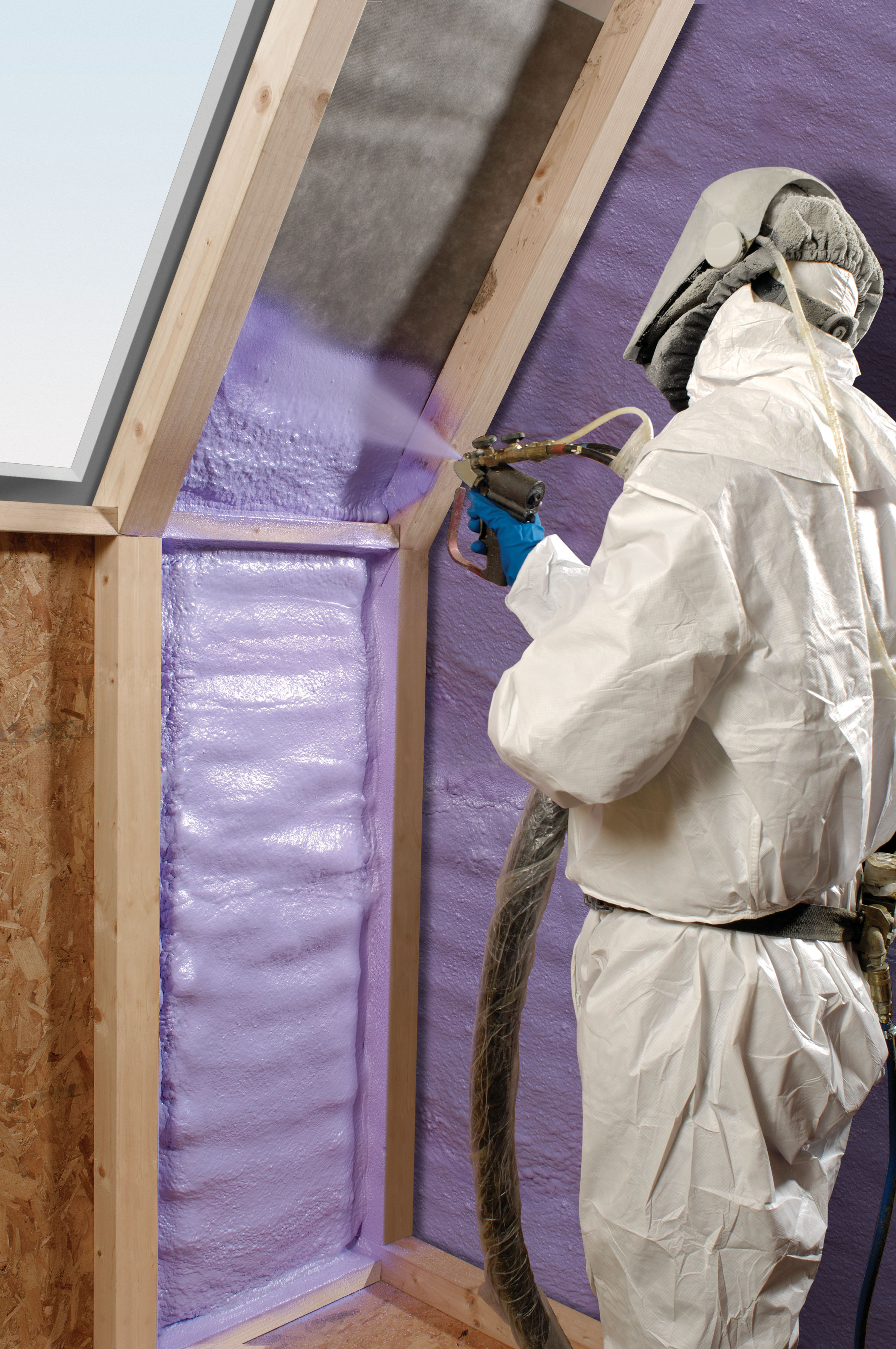
Closed-cell spray polyurethane foam (ccSPF) applied to the interior face of the sheathing or to the exterior provides both air barrier and insulation in a single material. At approximately R-6 per inch, it offers high thermal resistance in a thin layer and, unlike batts, conforms to irregular surfaces and eliminates gaps around framing members.
When used in a hybrid assembly — a layer of ccSPF on the stud interior face followed by batt insulation — the foam provides the vapour retarder, air barrier, and partial thermal resistance, while the batt fills the remaining cavity. This assembly is common in renovation work on existing stud walls where there is no access to add exterior ci.
Open-cell foam, by contrast, has a much lower R-value (approximately R-3.7 per inch) and is vapour-open, so it requires a separate vapour retarder on the warm side. It is less commonly used in cold-climate Canadian construction for exterior walls but does appear in cathedral ceiling assemblies where drying potential toward the exterior is maintained.
Advanced Framing
Advanced framing (also called optimum value engineering) reduces the amount of lumber in a wall by spacing studs at 600 mm (24 inches) on centre rather than 400 mm, eliminating redundant corner blocking, and using single top plates where structural loads allow. This reduces the framing fraction from roughly 25% down to 15–18%, improving the effective R-value of the assembly without adding any exterior insulation.
Advanced framing is well-documented by the Canadian Home Builders' Association and included in several provincial energy codes as a compliance pathway. It pairs particularly well with dense-pack cellulose or higher-density batts, which perform better at 600 mm spacing than standard batts that can sag and leave gaps at wider spans.
Measuring Results
The practical test of thermal bridging reduction is a blower door test combined with infrared thermography. The blower door measures air leakage — which, as noted in the vapour barrier article, typically contributes more heat loss than conduction through framing. Thermography under depressurization shows where air is leaking through the envelope and where framing members are conducting heat, making it possible to prioritize remediation efforts.
EnerGuide evaluations for existing homes include both a blower door test and an energy model, and the rating accounts for the actual framing fraction of the walls as built rather than assuming nominal insulation values. Homeowners who have had an EnerGuide assessment done often find the measured effective R-value of their walls is noticeably lower than what the original construction documents suggest.
Related Articles
Last updated: April 20, 2026. Figures reflect NBC 2020 and ASHRAE 90.1-2022 framing correction factors.